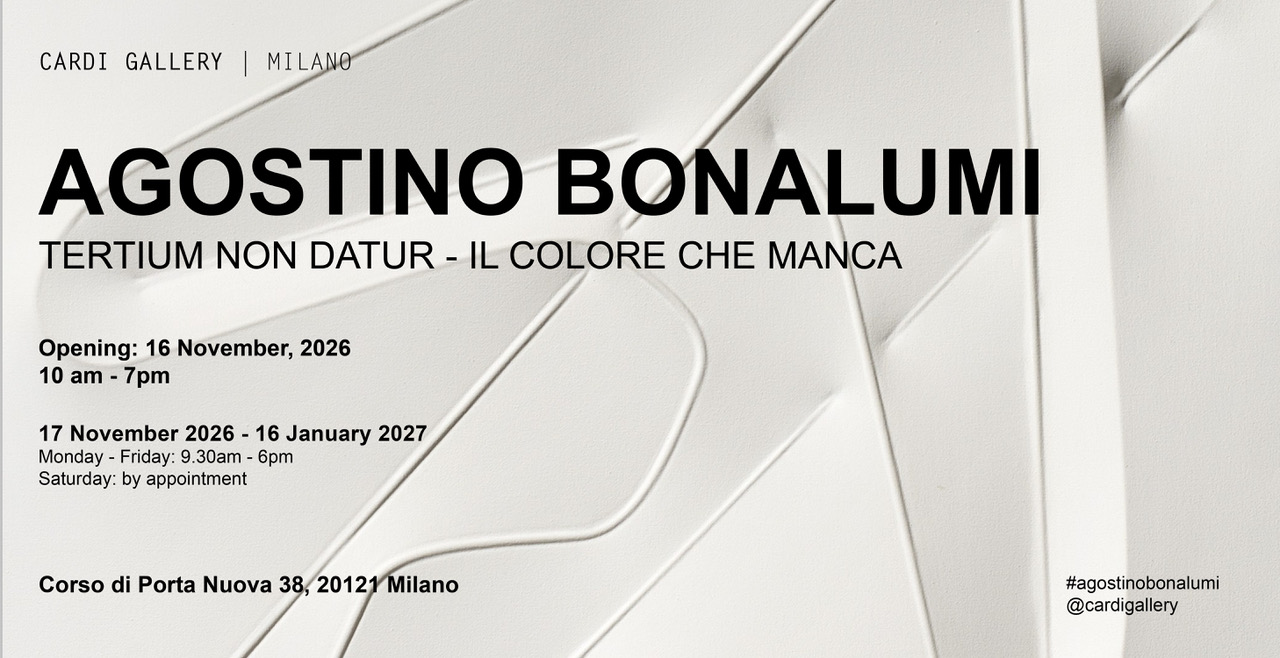
17 November - 16 January 2027
Agostino Bonalumi. Tertium non datur – Il colore che manca
In collaboration with Archivio Bonalumi
17 November 2026 – 16 January 2027
Opening: 16 November 2026, 10am–7pm
Cardi Gallery Milan is pleased to announce a solo exhibition dedicated to the work of Agostino Bonalumi, one of the defining figures of post-war Italian art. Organised in collaboration with Archivio Bonalumi, Agostino Bonalumi. Tertium non datur – Il colore che manca brings together over twenty monochromatic works from across the artist’s experimental career, offering a survey of his most significant series from 1964 to 2013, the year of his passing.
The title of the exhibition, a Latin phrase which refers to the law of excluded middle (‘no third is given’), takes a cue from the rigorous chromatic, formal and material investigations that formed the essence of Bonalumi’s art. Presented as a series of dichotomous encounters between black and white surfaces, the show traces successive cycles of works to which Bonalumi dedicated his career: from the first estroflessioni and fibreglass sculptures of the 1960s, through the grid series (1971–1989), to works on paper and metal sheet, as well as the steel wire canvases of his final decades.
The binary logic of the title extends to the artist’s iconic visual vocabulary, exemplified by the estroflessioni – picture-objects characterised by inverted and everted monochromatic surfaces, modular reliefs and hollows, and repeated geometric motifs that rely on the interplay of positive and negative space. In their sculptural modelling of inert, flat material, these groundbreaking works convey Bonalumi’s desire to give shape and expression to space itself, beyond mere representation.
“Monochrome is when colour does not write form, but colour itself (being light) is the possibility of form”, wrote the artist. From his earliest iterations of the shaped canvases – the first of which he created in 1959 – Bonalumi was drawn to notions of tension and reconciliation, the possibility of formalising the encounter between the physical world of matter and the intangible nature of artistic intent. His desire to move beyond the limits of post-war Pittura Informale aligned him with Milanese peers of the neo-avant-garde such as Piero Manzoni and Enrico Castellani, with whom Bonalumi formed the short-lived yet influential Azimut/h collective. Each of them followed the pioneering example of Lucio Fontana, whose earlier rupture of the canvas opened new, uncharted creative paths for a younger generation of artists. Bonalumi responded by approaching the painting itself – understood as an object made up of surface and support – as a non-representational space where “the possibility of form” lies within the inherent dialogue between light, colour and material.
Works like Nero (1964) and Bianco (1965) show the first signs of the artist’s emerging material sensibility and iconographic language, offering variations on a set of consistent geometric principles: the circle, the point, the rounded rectangle. Bonalumi uses these to expand and distort the stretched canvas into a volumetric field animated by light, achieved via specialised, handcrafted wooden structures and concealed padding.
“Despite the precision of their outlines and the strict linearity of their composition, they preserved an undisputed organic quality”, wrote critic Gillo Dorfles of these unclassifiable picture-objects in 1965. Indeed, the soft, almost anthropomorphic quality of Bonalumi’s early symbols is heightened by their handmade, artisanal execution. Bianco, a masterwork from 1965 defined by three circular forms arranged in vertical, overlapping sequence, suggests a more expansive, even cosmological scope. Combined with the pure white colour of the surface, such imagery positions the artist’s aesthetic inquiry within the lineage of Fontana’s post-war Spatialist investigations, while echoing the aspirations of his Zero group contemporaries.
Created shortly after, Bianco (1967) marks the beginning of a dramatic plastic evolution, which sees Bonalumi expanding the surface further beyond the bounds of the support, resulting in billowing, wave-like forms that reach well into the viewer’s domain. Two fibreglass sculptures, Bianco and Nero (both 1969), show Bonalumi’s pursuit of an increasingly environmental and tactile dimension. Monumental in scale, these enamelled works harness the glossy, reflective properties of their synthetic material to produce even more varied sensory and perceptual effects.
In 1974, Giulio Carlo Argan described Bonalumi’s evolving practice as fundamentally concerned with “gravity, density and reaction to light”. These principles are evident in the long-running grid series, to which the artist devoted much of the 1970s and 1980s. Characterised by increasingly detailed orthogonal structures, the series displays Bonalumi’s technical mastery and boundless sense of experimentation, resulting in rhythmic, striped geometric patterns that defy the boundary between two- and three-dimensional space. These intricate constructions offer countless variations on a set of mathematical rules, an approach Bonalumi extended to works on paper and collage (such as Seta bianca, 1987) and, at the end of the 1980s, to folded metal sheet (Nero, 1989).
Bonalumi took a freer, more lyrical turn during the 1990s, when he began to model the canvas from behind with lengths of steel wire, bent and shaped by hand to resemble lines drawn in space. Works such as Nero (1998) and Bianco (2001) mark a return to an almost gestural, fluid movement that implies the diffuse energy of a body in motion: the surface swells and recedes in sinuous, unpredictable rhythms. Through purely monochromatic means, Bonalumi here achieves infinitely subtle variations of light, shade and tonality, animating surfaces that seem to breathe from within – the culmination of a lifelong inquiry into the suprising, expressive potential of matter.
Where
Cardi Gallery
Corso di Porta Nuova, 30
20121 Milano